
That is the shape of the AI risk security teams now have to manage, and it is not the shape prompt filters were built for. AWS Bedrock Guardrails and Azure AI Foundry guardrails are filters: each judges a single prompt or response on its way to its own cloud’s models and returns a verdict. Netzilo is built as a bridge, an end-to-end detection and response platform for AI agents. A ship’s bridge sees the whole ship, understands how its parts relate, and can act on any of them.
The argument has three parts. The risk has moved from what models say to what agents do. A filter on one pipe cannot follow it. And a bridge has to do three things: see everything, connect the steps, and act on what it finds.
One request, one verdict
Every agent type, every surface, every platform
The whole chain, correlated, with its kill chain
Inspect, isolate, AI Kill Switch, in seconds
↺ a response tightens detection
The risk moved from what models say to what agents do
A chatbot only talks. An agent acts: it calls tools and MCP servers, reads and writes files, starts processes and opens network connections. Everything it does falls on one of three surfaces.
- Prompts. What the agent and its model say to each other, including files and answers.
- Tool use. The tools, MCP servers and APIs the agent calls, and what they send back.
- The machine. The processes it starts, the files it reads and writes, and the connections it opens.
Attackers use all three. A poisoned tool response steers the agent before any model reads it. A credential file read never becomes a prompt. And the steps that matter are rarely suspicious one at a time: they become an attack only in sequence. Defending agents means watching the whole chain, not only the conversation.
A filter on one pipe cannot see an attack in sequence
Bedrock Guardrails and Foundry guardrails are good at what they were built for: classifying content sent to and from their own models. Measured against agents, they share three structural limits.
- One surface. They judge prompts and responses. Bedrock Guardrails do not evaluate tool definitions, tool-call arguments or tool results (AWS documentation). Foundry’s tool checks are in preview and cover a fixed list of tools that does not include MCP (Microsoft documentation).
- One request at a time. Each prompt is judged on its own. AWS comes closest: AgentCore session policies can recall earlier tool calls, but only those made through AgentCore Gateway. Microsoft’s nearest feature, Task Adherence (preview), checks an agent’s tool actions against the user’s intent, one request at a time.
- One verdict. The answer is allow, block or mask the request. Neither vendor documents a guardrail that inspects or isolates an agent session. Microsoft Defender can isolate a whole device or disable a user, which stops everything on it, not only the agent.
Each limit has a counterpart in what a bridge must do: see everything, connect the steps, and act on what it finds.
Step 1: See everything
The first job of a bridge is to leave nothing in the dark. Netzilo watches every AI session in the enterprise from one platform and one console.
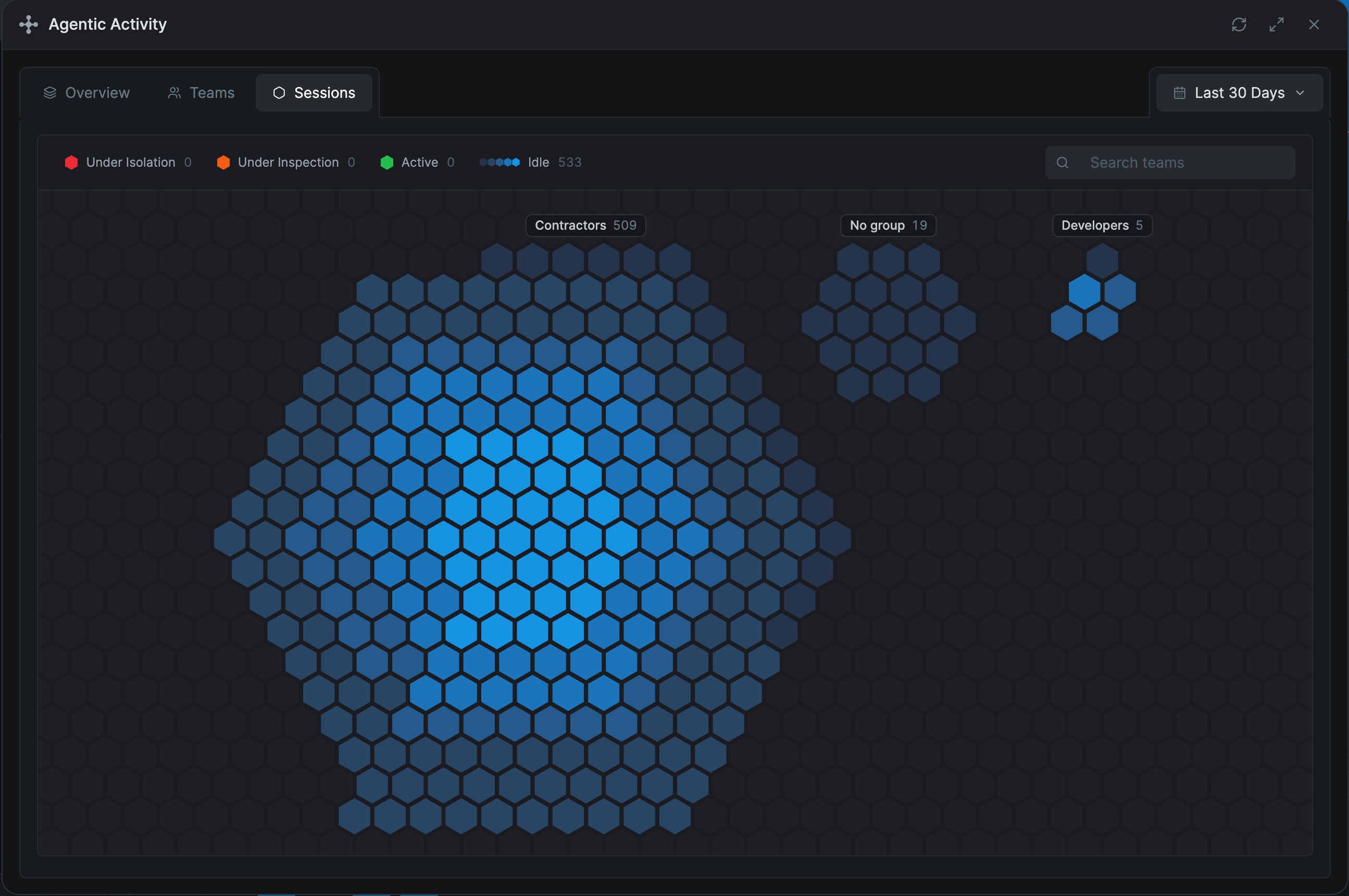
Coverage has three dimensions.
- Every agent type. Homegrown agents your teams build, general-purpose agents people install (Claude Code, Cursor, desktop assistants), and SaaS agents that live in web pages (ChatGPT, Gemini).
- Every surface. Prompts, tool and MCP traffic, and process, file and network activity, each checked where it happens: a tool response as it reaches the agent, a tool call before it runs, a file read as the agent causes it.
- Every platform. Laptops, servers, browsers and the AI Gateway, in front of any model provider, Bedrock and Azure OpenAI included. One rule language works everywhere, so changing provider changes no guardrail.
| Netzilo | AWS Bedrock | Azure Foundry | |||||||||
|---|---|---|---|---|---|---|---|---|---|---|---|
| Prompts | Tool use | Process | Prompts | Tool use | Process | Prompts | Tool use | Process | |||
| Homegrown | Yes | Yes | Yes | Partial | Partial | Partial | Partial | Partial | Partial | ||
| General purpose | Yes | Yes | Yes | Partial | No | No | Partial | Partial | Partial | ||
| SaaS (web) | Yes | Yes | Yes | No | No | No | Partial | No | No | ||
Cloud guardrails cover the cells next to their own models. The rest is partial, in preview, or sold as separate products.
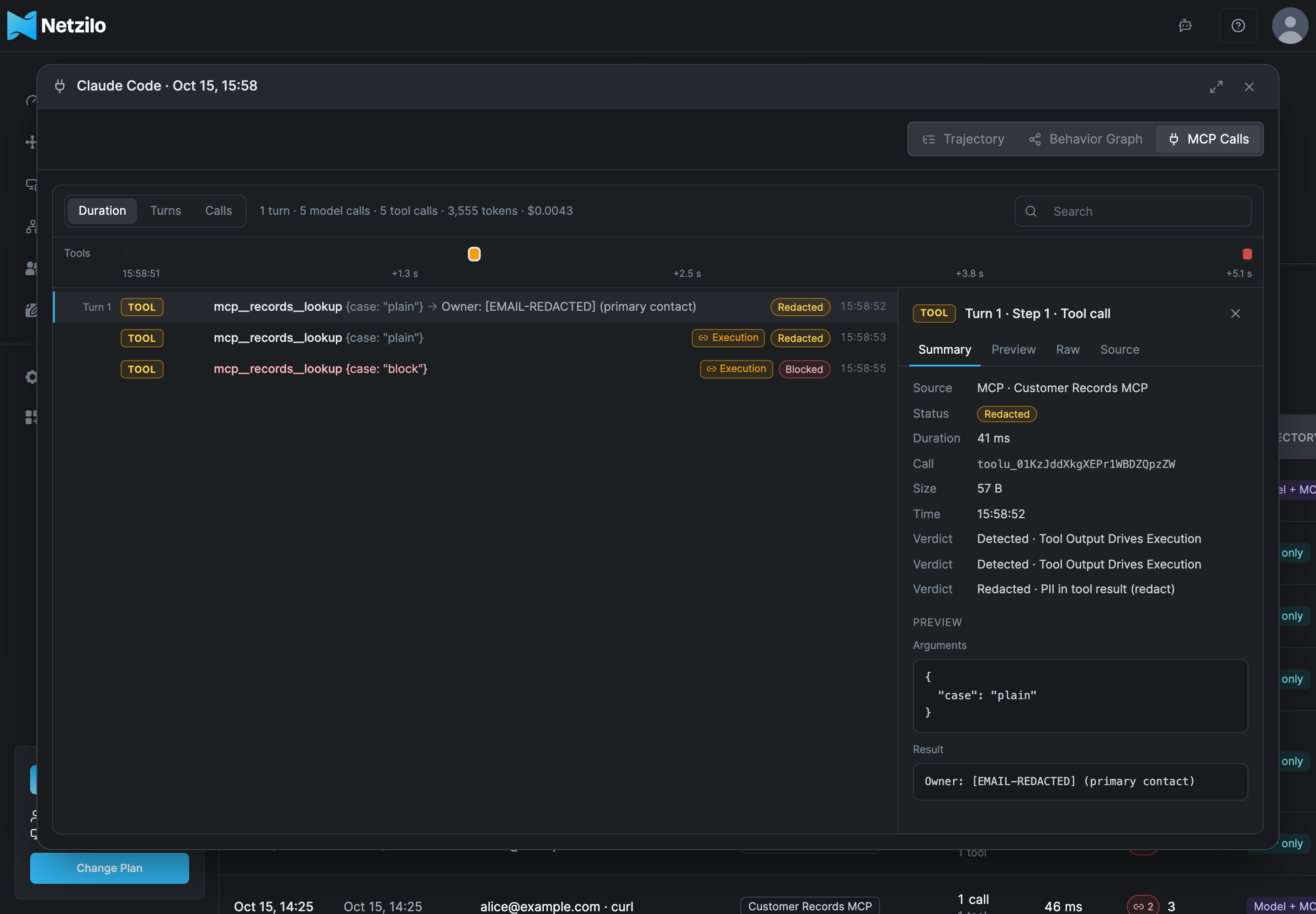
The tool surface is where that gap costs most. Netzilo judges each MCP tool result as it reaches the agent, before any model sees it, and redacts what should not pass.
Step 2: Connect the steps
Seeing is not enough. The steps that make an attack are individually ordinary, so a guardrail has to read them as one chain. A Netzilo guardrail is a program, not a pattern. It keeps state across the whole agent session, correlates prompts, tool calls, processes, files and connections, and can call an AI judge when a decision needs one.
Take the scenario from the start.
Poisoned tool description tells the agent to fetch a deploy skill
VS Code downloads the skill from a never-seen public host
Agent runs aws sts assume-role: routine DevOps on its own
Sends data out with the new keys via a routine-looking API call
not evaluated
a model
not evaluated
not evaluated
a coding agent in VS Code is not one
recorded, judged
untrusted skill
the kill chain
The agent downloads a skill from an unfamiliar host, then asks for cloud credentials. The credential request is routine on its own, and the download never reaches a model. Netzilo’s behavior monitor records the download against the session, so a guardrail on the credential call can see it and refuse.
This is not hypothetical. Netzilo’s Claw Chain guardrail catches the same shape on real telemetry: an untrusted fetch, a shell trick that hides the command, a credential read, then a connection to the cloud metadata endpoint. Every step is a process, a file read or a connection, and none is a prompt.
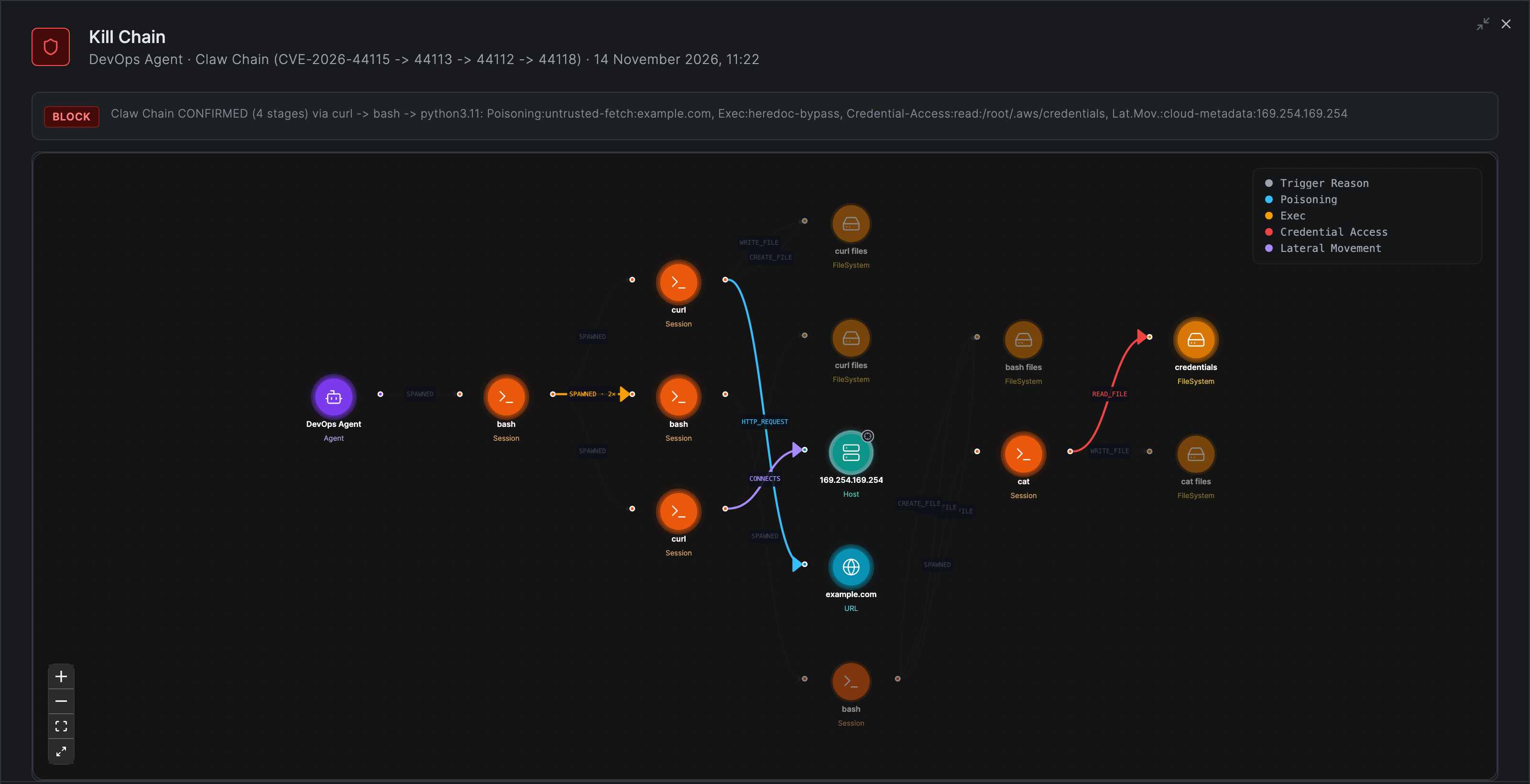
The result is not a verdict on one request but a kill chain: the evidence of every step that led to the decision, ready for the security team to review.
Step 3: Act on what you find
Detection that waits for a person is too slow for an agent that acts in seconds. Netzilo guardrails respond on their own, and they do it as a team: they share one record of each session, so one guardrail’s finding changes what the next one does.
Cruise Control is the simplest example: four guardrails, one escalation.
- Watch. Gate checks tool calls before they run and judges the risky ones against what the user asked for. Patrol follows the whole session in the background. When it finds drift, injected instructions or likely harm, it puts the session under watch, and Gate then judges every action that is not a read.
- Inspect. Inspection marks the session Under Inspection on every device, browser and gateway that carries it.
- Isolate. If Gate blocks another action, Containment isolates the session. All of its AI activity stops everywhere, with no one watching.
Each tool call labelled; risky ones judged
Every action except reads is judged
Shown on every device, browser and gateway
All AI activity of the session stops
Every guardrail reads what the others found:
- ·untrusted content the agent read
- ·sensitive data it touched
- ·each action and its verdict
- ·whether the session is under watch
- ·the response action in force
Each finding raises the next guardrail’s scrutiny
Isolation reaches devices in under 1 s, AI Gateways in about 2 s, browsers in about 30 s.
The same actions are available by hand. The AI Kill Switch stops all AI activity of an agent, a device, a user, a group or the whole account in one action. Isolation reaches devices in under a second, AI Gateways in about 2 seconds and browsers in about 30 seconds, and it holds through restarts and while the Netzilo Server is unreachable.
Teams need not be elaborate. Each of these is two short guardrails: one notes a finding in the session record, and the other acts on it.
| Team | One guardrail notices | Another acts |
|---|---|---|
| Untrusted input locks outbound | A tool result came from email or the web and carries instructions addressed to the agent | Blocks any send, post or upload for the rest of the session |
| Sensitive read, then no upload | The agent read customer records or a credentials file | Blocks a file upload or an external message from the same session |
| Three strikes | Each guardrail in the team records its blocks in the session | On the third block, puts the session Under Inspection |
| Inspection-aware | An administrator or a guardrail placed the session Under Inspection | Isolates the session the moment the agent tries to send email |
The last team is an example in Netzilo’s documentation. The others are patterns anyone can build with the same engine.
The test to apply to any AI guardrail
The argument reduces to six questions. They work on any vendor, Netzilo included.
| Question | AWS Bedrock Guardrails | Azure Foundry guardrails | Netzilo |
|---|---|---|---|
| Does it cover every agent type: homegrown, general-purpose and SaaS? | Agents on Bedrock or AgentCore | Foundry agents; others through separate products | Yes |
| Does it see tools and machine activity, not only prompts? | Prompts; tool calls and results not evaluated | Prompts; tool checks in preview, no MCP | Prompts, tools, processes, files and network |
| Does it analyze the whole chain of activity? | One request at a time | One request at a time | Yes, correlated across the session |
| Do guardrails act on each other’s findings? | Session policies recall earlier gateway calls | Not documented | Yes, through one shared session record |
| Can it contain an agent on its own? | Block or mask the request | Block or annotate; Defender isolates a whole device or user | Yes: inspect, isolate or AI Kill Switch, on every host in seconds |
| Is it independent of one cloud? | Bedrock; other models through your own code | Foundry and Azure OpenAI; others through API Management | Yes: every platform and model provider, one rule language |
The bottom line
None of this means discarding cloud guardrails. Keep Bedrock Guardrails or Azure Content Safety where an application already runs on that cloud’s models: their content classifiers are mature and inexpensive. Add Netzilo to govern what agents do, meaning their tools, their sessions and your response, on laptops, in browsers and at the gateway. Netzilo’s AI Gateway fronts Bedrock and Azure OpenAI as providers, so teams keep the models they use today.
A filter tells you a prompt was blocked. A bridge tells you what the agent did, why it mattered, and stops it from doing more.
Sources
Vendor capabilities are as documented on 14 November 2026.
- AWS: Bedrock Guardrails with the Converse API, ApplyGuardrail, AgentCore Policy, AgentCore temporal policies
- Microsoft: Foundry guardrails overview, Foundry intervention points, Task Adherence, Defender AI agent runtime protection, Defender custom detections, Purview DSPM for AI, API Management content safety policy
- Netzilo: Guardrails, Detection Rules, Behavior Graph and Kill Chains, Response Actions
Ready to put a bridge over your AI agents?
Discover how Netzilo sees every agent, connects the steps of an attack, and acts on what it finds, from inspection to an AI Kill Switch.