
The Decoy Enterprise: A Decoy for Every App, MCP Server and AI Gateway
ARTEX is an open-source framework in which AI agents run a penetration test on their own: they find what an organization exposes, try it, and keep going. It appeared on GitHub in July 2026. By November the FBI was warning that multiple threat actors have weaponized it since at least August, against financial, government, technology, defense and healthcare organizations, and that it lets attackers “with minimal technical expertise” run complex operations against many targets at once. Unit 42 counted 609 internet-facing hosts running it in October, and found that it “can act on a stolen credential within a minute of finding it.”
The systems these agents are best at are the ones teams forget: partner portals, employee applications, legacy services, third-party integrations. Today that list also includes MCP servers and AI gateways. And the fastest way in is the simplest. In StepSecurity’s words: “The agents get in fastest with a credential someone left in the open.”
Unit 42’s own advice points the way: “Defenders may be able to take advantage of this to trick attackers using AI-powered red teaming tools into wasting resources.” An agent that believes what it finds can be shown exactly what you want it to find.
Introducing the Decoy Enterprise
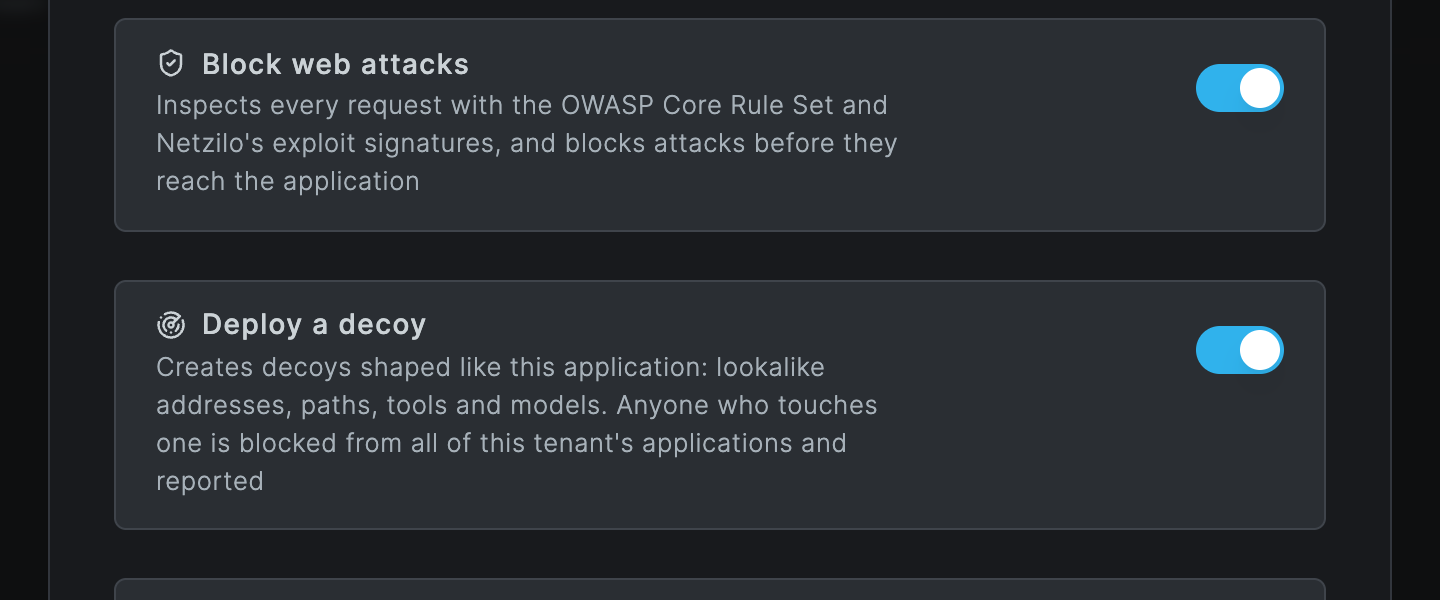
Every application, MCP server and AI gateway you publish through Netzilo can now bring its own decoys. Turn on Deploy a decoy and Netzilo surrounds what you published with lookalikes built from its own configuration. Turn on Block web attacks and a web application firewall stands in front of the real thing. Two switches, and no other configuration.
It is not limited to websites. Anything published through Netzilo, whether a web application, an MCP server your agents call or the AI gateway in front of your models, gets decoys shaped like itself. The whole public face of the company becomes a field of lookalikes, with the real systems hidden among them.
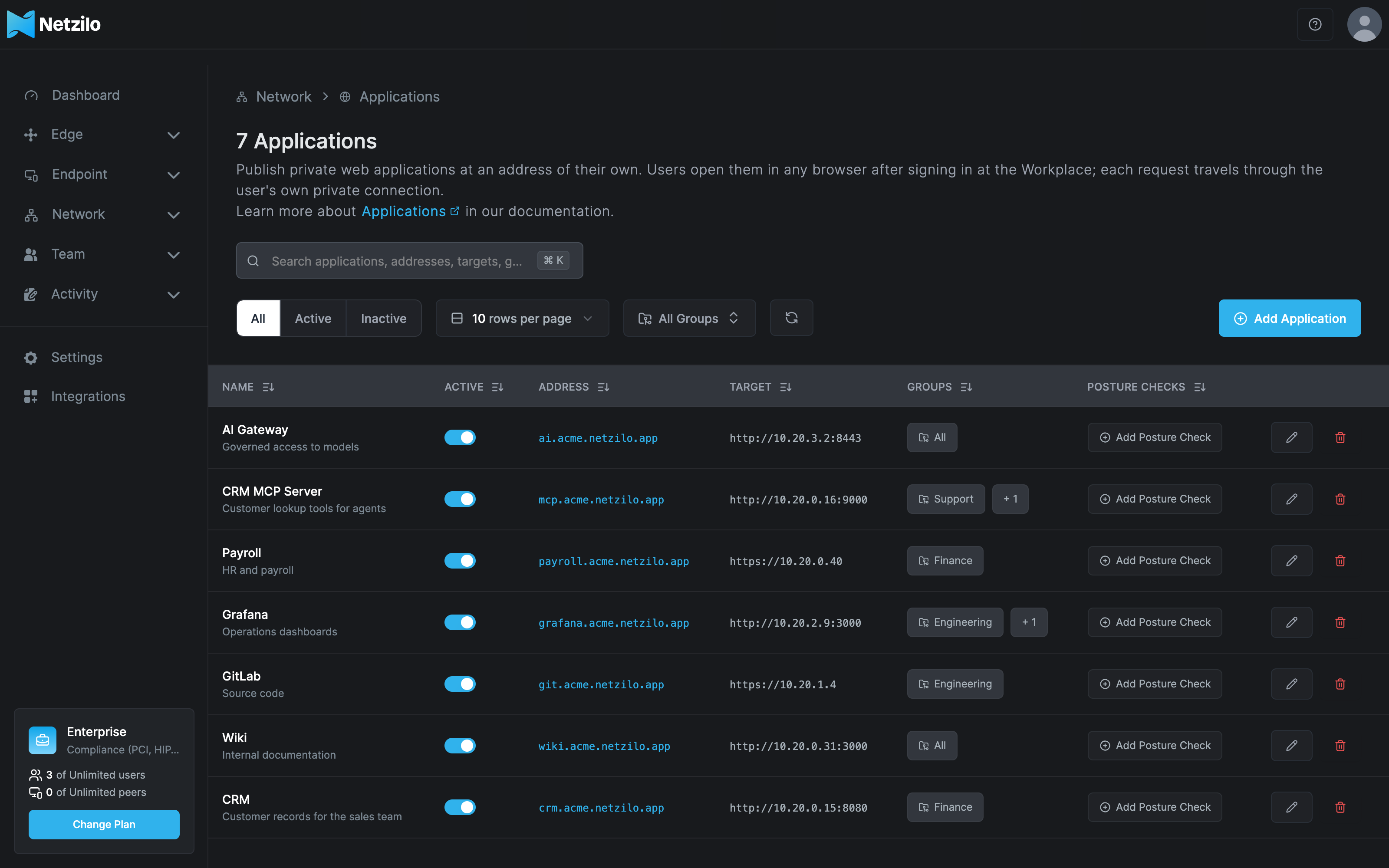
Decoys shaped like what you publish
A decoy only works if it is believable, and a generic honeypot is not. So Netzilo builds each decoy from the configuration of the application it protects. There is nothing to design, place or maintain.
- Web applications get lookalike addresses next to theirs (a
gitlab-stagingbeside the real GitLab) and the files attackers hunt for:.env,.git/config, backups, admin and login pages. - MCP servers get a lookalike MCP server whose tools mirror the real tool list and return synthetic records. An agent that calls one has announced itself.
- AI gateways get a lookalike gateway that lists the same models and accepts planted API keys. A key that was never handed to anyone is proof of intent the moment it is used.
- Every published address gets the credentials attackers want most: configuration files and cloud keys that look real and lead nowhere.
When an application changes, its decoys change with it. When you publish something new, it arrives with decoys of its own.

/wp-login.php on a protected address: a decoy. The real application is not WordPress and is not reachable without signing in. Screenshot from a Netzilo test environment.The bait is the credential an agent like ARTEX is looking for. Every value is synthetic:
$ curl https://crm.acme.netzilo.app/.env
APP_NAME=Dashboard
DEBUG=true
APP_KEY=base64:asHnYlHgu1aP44AYubstQN4itHsLjaD1=
DB_CONNECTION=mysql
DB_HOST=127.0.0.1
DB_PORT=3306
DB_DATABASE=dev_database
DB_USERNAME=user
DB_PASSWORD=wpVlG1Pyl6VQ
AWS_ACCESS_KEY_ID=AKIAJI533KZ36ZCBK2MB
AWS_SECRET_ACCESS_KEY=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
STRIPE_SECRET=key_5eAb1RVJQ4fqhDeNLSZecBGSu6HEP4T3Blocked everywhere, reported at once
No legitimate user ever touches a decoy: the real systems sit behind sign-in and have no reason to. So a decoy hit is not a score or a guess. It is a verdict.
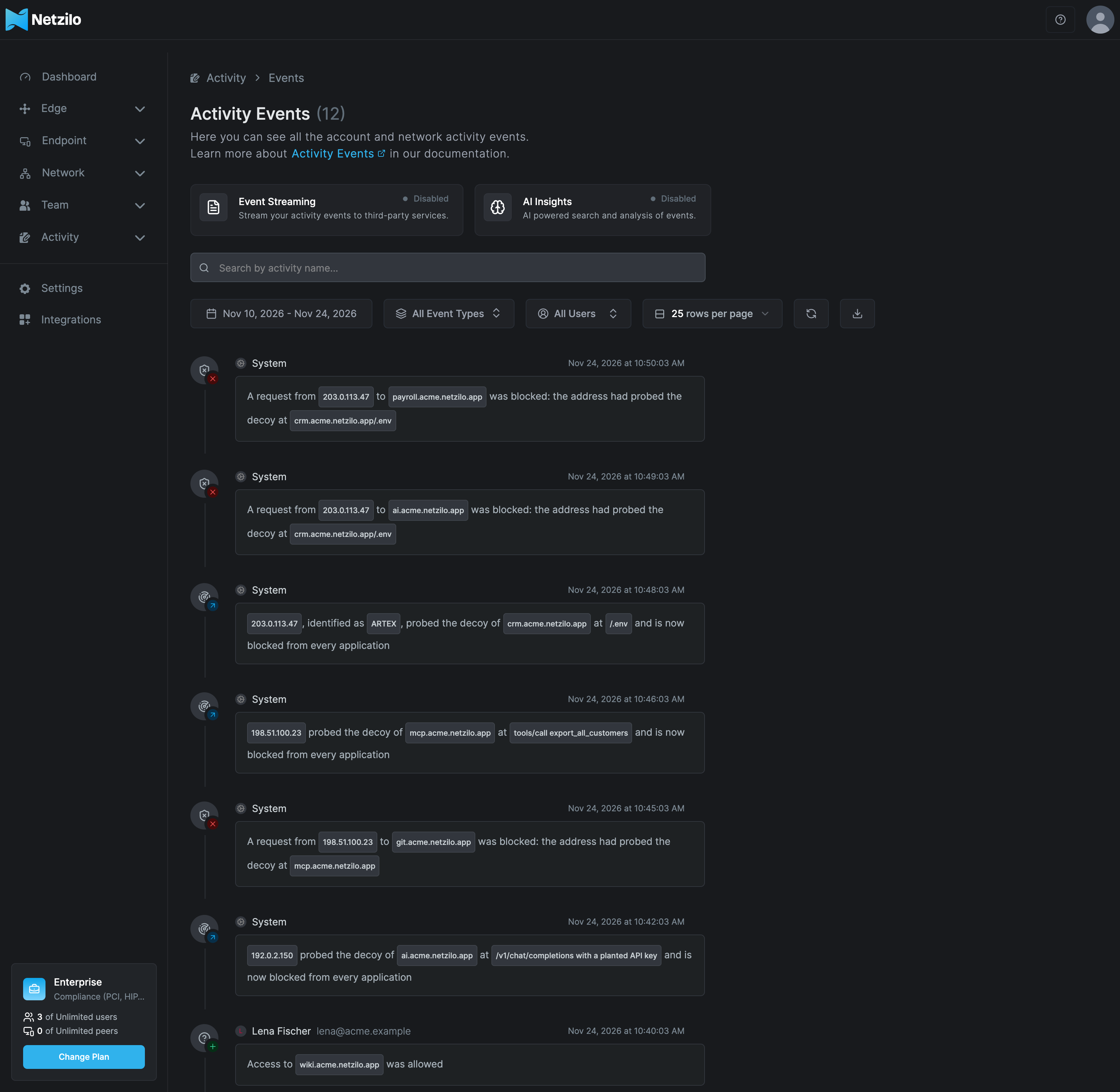
The moment an address touches any decoy, Netzilo blocks it from every application, MCP server and AI gateway in the tenant, including the ones it has not found yet. The agent that read a fake .env on the CRM never reaches Payroll. Every hit and every block that follows is reported in Activity, with the address, the decoy it touched and, where the traffic matches published ARTEX indicators, the tool that sent it. Event Streaming carries the same events to your SIEM.
A firewall for the attack itself
Decoys catch the reconnaissance. Block web attacks stops the exploit. The Netzilo reverse proxy inspects every request before passing it on, against two rule sets.
- The OWASP Core Rule Set, the open rule set behind most web application firewalls (coreruleset.org), for whole classes of attack: SQL injection, cross-site scripting, path traversal, remote code execution and protocol abuse.
- Netzilo exploit signatures for more than 2,400 specific CVEs, in the products companies most often publish. A signature does not see “a strange path”; it recognizes the exploit and names the CVE.
Rules update continuously, without restarts and without dropping a user session. The exploits agents try against decoys are the signatures enforced first, so the firewall in front of your systems follows what attackers did this week. A blocked request never reaches the application.

Turning it on
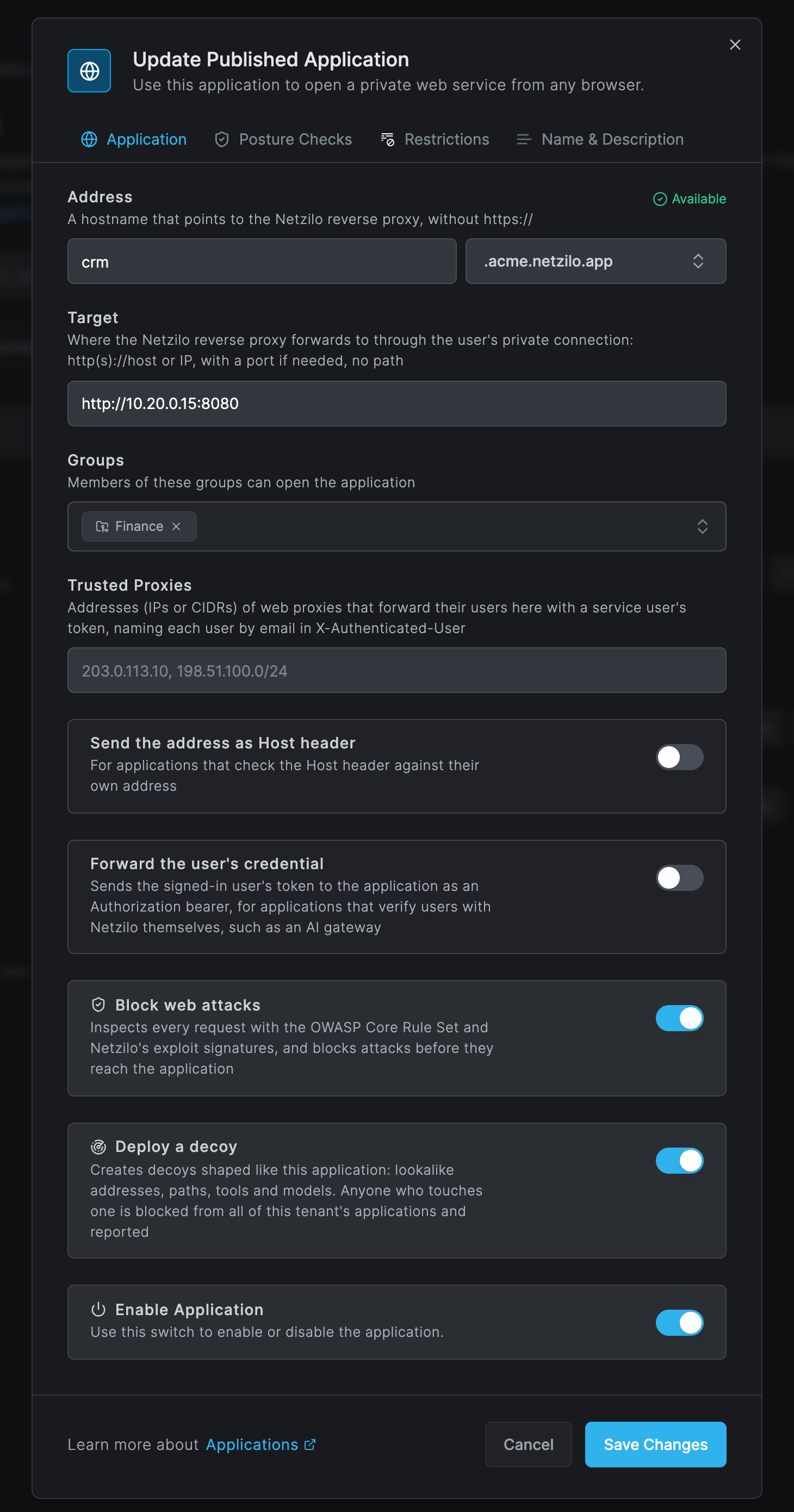
- In the Netzilo dashboard, open Network → Applications.
- Open an application, MCP server or AI gateway, or add a new one.
- Turn on Block web attacks and Deploy a decoy.
- Click Save Changes.
That is all. There is no agent to install, no DNS record to add, no decoy to design and nothing else to deploy: the reverse proxy that already publishes the application does the work.
The bottom line
AI agents made reconnaissance cheap. They will look at everything you expose, and they will believe what they see. The Decoy Enterprise turns that against them: for every application, MCP server and AI gateway you publish, there are lookalikes that cost an attacker their access the moment they touch one.
Two switches. Every public system decoyed, every attacker blocked and reported.
Sources
- Unit 42: ARTEX and AI-Powered Red Teaming Tools: What Defenders Need to Know (November 11, 2026)
- StepSecurity: ARTEX: Attackers Adopted This AI Pentesting Tool in Three Months. Leaked Secrets Are Its Fastest Way In. (November 12, 2026)
- BleepingComputer: FBI warns ARTEX AI hacking tool is powering global cyberattacks (November 15, 2026)
- OWASP Core Rule Set
Bring the Decoy Enterprise to your company
See how Netzilo publishes your applications, MCP servers and AI gateways with a decoy beside each one and a firewall in front.